
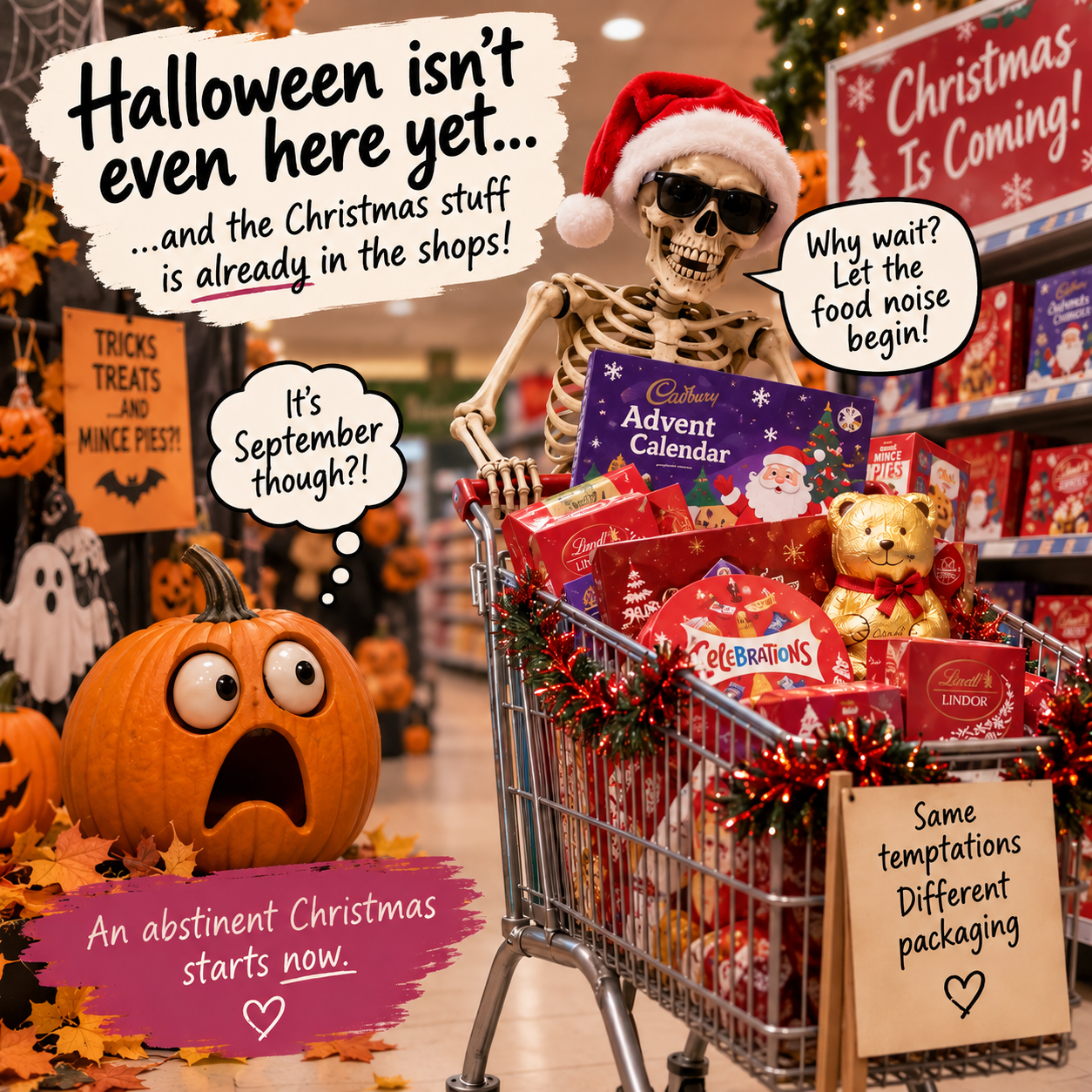
Christmas food now appears in shops months before December. Ellen Bennett explores how this extended season shapes our eating habits, and why planning ahead can matter for people with food addiction.
Halloween isn’t even here yet, and the advent calendars are already out. I first spotted them in September and, honestly, my first thought was: it’s September though?
For most people, that probably just feels like ridiculously early Christmas marketing. But the more I thought about it, the more I wondered what this actually does to us.
Because Christmas food no longer seems to arrive at Christmas. It starts creeping into shops at the end of summer.
First the advent calendars. Then the tubs of chocolates. Then mince pies, festive biscuits, Christmas drinks, party food and limited-edition everything.
By the time December arrives, some of us have been exposed to Christmas food for three months.
So when did a Christmas treat become a four-month eating season?
We don't have to eat something for it to affect us
One of the things we understand about eating behaviour is that food cues matter.
Our brains learn associations between food and everything surrounding it: packaging, places, smells, adverts, particular times of year and even emotions. Over time, simply seeing a food can start to trigger anticipation, craving and thoughts about eating it.
A meta-analysis by Boswell and Kober looked at 45 studies involving more than 3,000 people and found that food cue reactivity and craving predicted subsequent eating and weight-related outcomes.
And this wasn't only about having the food physically in front of you. Visual food cues, such as pictures and videos, were also associated with later eating behaviour.
That matters when we think about what happens every time we walk into a supermarket from September onwards.
You might walk past the advent calendars. You might not buy the tub of chocolates at the end of the aisle. You might ignore the mince pies stacked next to the checkout.
But that doesn't necessarily mean your brain hasn't noticed them.
Marketing isn't just there to tell us something exists
There is sometimes an assumption that advertising simply gives us information. It doesn't. Marketing is designed to influence behaviour.
Research looking at food advertising has found that exposure can increase subsequent food intake, and this effect has been demonstrated in adults as well as children.
And advertising is only one part of it. Food marketing includes where products are placed, how they are packaged, pricing, promotions, colours, imagery, limited editions and the constant message that this is something we should want.
Think about Christmas in a supermarket. The same foods appear at the end of aisles, at the checkout, stacked into enormous displays and wrapped in shiny red, gold and green packaging.
The message is difficult to miss. Christmas is coming. Buy this. Eat this. Stock up. Treat yourself.
Except Christmas isn't actually here yet.
What happens when a treat stops being unusual?
I think this is the bit we don't talk about enough.
Treats are, by definition, meant to be occasional.
A mince pie in December feels seasonal. A chocolate advent calendar belongs to December. A tub of chocolates might traditionally have been something that appeared in the house close to Christmas.
But if those same foods are available from September onwards, something changes.
They stop being unusual.
We get used to seeing them. We get used to having them around. And eventually they just become part of the normal food environment.
The extraordinary becomes ordinary.
That doesn't mean that seeing a mince pie in September causes illness. Of course it doesn't.
But food behaviour doesn't happen in isolation. It happens within an environment that constantly influences what is available, what seems normal, what we think about and what we eventually eat.
And if that environment encourages us to eat highly rewarding foods for three or four months rather than a few days, then perhaps we need to question whether we can still genuinely describe them as occasional treats.
Then Christmas actually arrives
There is evidence that body weight tends to increase over festive periods.
A systematic review examining festive periods found that around 70% of observational studies reported significant weight gain, with the average increase being around 0.7 kg.
That might not sound enormous. But another concern raised in research is that some people do not completely lose that additional weight afterwards.
And, of course, weight is only one part of the picture. For some people the festive period can also mean disrupted routines, increased alcohol intake, more frequent eating, larger portions, poorer glycaemic control and the familiar January cycle of guilt, restriction and trying to “undo” December.
The point isn't that Christmas food is inherently bad. The question is whether stretching the Christmas eating environment across several months makes any of this easier.
For someone with food addiction, this can feel very different
Now imagine the same environment when particular foods trigger powerful cravings, food noise, compulsive eating or loss of control.
For someone experiencing food addiction, Christmas doesn't start on 25 December. The exposure starts months earlier.
The supermarket displays start. Then the adverts. Then the festive coffees. The tubs of chocolates appear at work. Someone brings mince pies into the office. Christmas markets start. Restaurants launch Christmas menus. Social media fills with Christmas recipes.
And eventually we start hearing: “Go on, it's Christmas.”
Except we've potentially been hearing some version of that message since September.
There is another difficulty here too. Seasonal triggers are unusual because we don't necessarily get regular exposure to practise dealing with them.
If Christmas was difficult last year, you may have gone almost twelve months without facing some of those particular foods or situations again.
Then suddenly they're everywhere.
That is one reason I think people recovering from food addiction need to start thinking about Christmas long before December.
An abstinent Christmas starts now
If you know certain foods cause you to lose control, you do not need to wait until you're standing in front of the Christmas buffet to decide what you're going to do.
You can decide now.
- What foods are a problem for me?
- What am I going to eat at Christmas?
- What will I do at parties?
- What happens if somebody buys me food as a gift?
- What will I say when somebody tells me that “one won't hurt”?
- What food am I comfortable having in my own home?
- Who will I speak to if my food noise suddenly increases?
- And what Christmas traditions can I enjoy that have absolutely nothing to do with eating?
These decisions are much easier to make when your midbrain isn't already screaming at you.
Preparation doesn't mean being frightened of Christmas. It means giving yourself a plan before you need one.
And if you don't have food addiction…
Maybe just start noticing.
Notice when the Christmas food first appears. Notice how often you see it. Notice how much space it takes up in supermarkets.
Notice the words being used around it: treat, indulge, irresistible, naughty, magical. Notice how enormous tubs of food become associated with generosity and celebration.
And notice whether something you once ate only at Christmas gradually becomes something you start eating in October.
None of this means we can't enjoy food at Christmas. But perhaps Christmas food deserves to become special again.
And perhaps we should be more understanding of people who need to say no to some of it altogether.
Because Halloween hasn't even arrived yet. Christmas certainly hasn't.
Our food environment, however, apparently didn't get the memo.
References
-
Boswell RG, Kober H. Food cue reactivity and craving predict eating and weight gain: a meta-analytic review. Obesity Reviews. 2016;17(2):159–177.
-
Arrona-Cardoza P, Labonté K, Cisneros-Franco JM, Nielsen DE. The Effects of Food Advertisements on Food Intake and Neural Activity: A Systematic Review and Meta-Analysis of Recent Experimental Studies. Advances in Nutrition. 2023;14(2):339–351.
-
Boyland E, et al. Food marketing, eating and health outcomes in children and adults: a systematic review and meta-analysis. British Journal of Nutrition. 2025;133(6):781–805.
-
Zorbas C, et al. The Relationship Between Feasting Periods and Weight Gain: a Systematic Scoping Review. Current Obesity Reports. 2020;9(1):39–62.