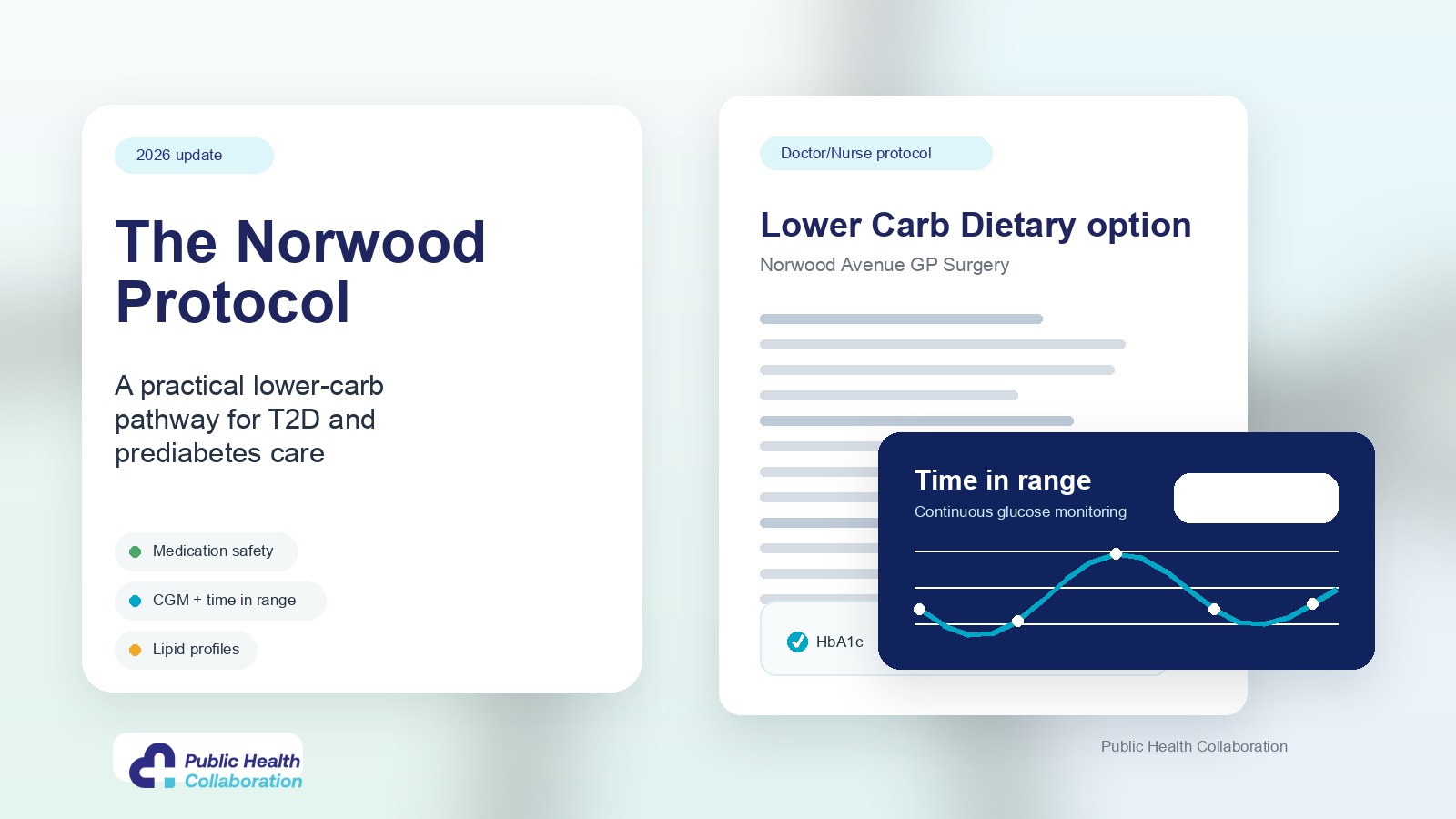
The Norwood Protocol has been updated for 2026, with clearer guidance on lipid profiles, continuous glucose monitoring and the latest evidence on weight loss and type 2 diabetes remission.
The Norwood Protocol has always been a practical document. It is not a theoretical paper or a diet manifesto. It is a clinic-room guide for doctors and nurses supporting people with type 2 diabetes or prediabetes who want to try a well-formulated lower-carbohydrate approach.
The updated 2026 version is now available to download from PHC’s resources page: The Norwood Protocol.
At its heart, the protocol reflects a simple but powerful idea: people are more likely to change when they understand what is happening in their own body, can see progress, and are supported safely as medication needs change.
What is the Norwood Protocol?
The protocol comes from the work of Norwood Avenue GP Surgery in Southport, where Dr David Unwin and colleagues have spent many years helping patients improve blood glucose, weight, blood pressure and metabolic health through practical dietary change.
The wider story behind that work is also covered in Dr David Unwin's Telegraph article on helping 150 people reverse type 2 diabetes, published on 8 June 2026: read the Telegraph article.
It is written for clinicians. It covers the first appointment, early review, follow-up blood tests, medication safety, use of EMIS codes, and the practical questions that come up when people reduce dietary carbohydrate.
It also keeps the conversation human. The protocol encourages clinicians to approach high blood sugars as an “interesting puzzle” to work through with the patient. That tone matters. Type 2 diabetes care is not only about targets and thresholds; it is also about motivation, confidence, feedback and trust.
Why the update matters
The latest version keeps the practical structure of the original protocol, but brings several areas up to date.
First, it strengthens the section on lipid profiles. The update moves beyond looking only at total cholesterol and encourages a fuller risk discussion using fasting lipid profiles where possible. It specifically highlights triglycerides, HDL, LDL and the cholesterol/HDL ratio as part of a more useful cardiovascular risk picture.
Second, it expands the section on continuous glucose monitoring. More people with type 2 diabetes are now buying or using CGM devices, even when they are not using insulin. The protocol reflects that real-world shift. It discusses time in range, estimated HbA1c from CGM, and the need to look at daily glucose patterns rather than relying on a single headline number.
Third, it adds newer evidence on weight loss and type 2 diabetes remission. A 2025 systematic review and meta-regression in The Lancet Diabetes & Endocrinology found a strong dose-response relationship between bodyweight loss and remission outcomes in randomised trials. The protocol uses this evidence to reinforce the importance of weight loss as one route to better blood sugar control and remission.
Finally, the references have been refreshed. The updated protocol now includes 16 references, including additional evidence on triglycerides, low-carbohydrate diets and metabolic risk factors, CGM outcomes, and bodyweight loss in type 2 diabetes remission.
Safety remains central
One of the most important parts of the protocol is medication safety.
When someone with type 2 diabetes significantly reduces carbohydrate intake, glucose levels can improve quickly. That is good news, but it can also mean that medication needs reviewing quickly. The protocol highlights three practical risks clinicians need to consider:
- hypoglycaemia, especially in people taking insulin or sulfonylureas such as gliclazide
- diabetic ketoacidosis risk with SGLT2 inhibitors, including the possibility of euglycaemic DKA
- hypotension as weight and blood pressure improve
This is why PHC always frames low-carb resources for people on diabetes or blood-pressure medication as something to discuss with their GP, nurse, pharmacist or diabetes team. A lower-carbohydrate approach can be powerful, but the medication context matters.
A more practical conversation about cholesterol
The lipid section is one of the clearest changes in the update.
The protocol now makes the point that total cholesterol alone can be a blunt measure. A fuller fasting lipid profile can help clinicians and patients build a more nuanced picture of risk, particularly when triglycerides, HDL and cholesterol/HDL ratio are considered alongside LDL cholesterol and the wider clinical context.
This matters because people often worry when cholesterol numbers change during dietary change. A better conversation is not “is cholesterol up or down?” but “what does the whole risk picture look like, and what has changed in weight, blood glucose, blood pressure, triglycerides, HDL and other markers?”
That approach is more useful for patients and more clinically responsible for practitioners.
CGM is changing the consultation
Continuous glucose monitoring is also changing how people understand food.
For many patients, CGM turns an abstract HbA1c result into a visible daily pattern. It can show which meals create large glucose rises, how long glucose stays elevated, and how changes to food choices affect time in range.
The updated protocol is careful not to overclaim. It recognises that the place of CGM in routine care for people with type 2 diabetes not using insulin is still developing. But it also acknowledges what many clinicians are seeing: patients often learn a great deal from the feedback.
Used well, CGM can support the same principle that runs through the whole Norwood approach: feedback helps behaviour change.
The NICE context
The update also sits in a changing guideline landscape.
NICE’s 2025 overweight and obesity management guideline recommends a flexible and individualised approach to dietary interventions. It also explicitly notes that an energy deficit can be achieved by lowering specific macronutrient content, including low-fat or low-carbohydrate diets.
That does not mean every person should be given the same dietary plan. It means low carbohydrate can be discussed as one legitimate option within individualised care, with nutritional balance, follow-up and appropriate support.
For people with type 2 diabetes or prediabetes, that individualisation is essential. The best plan is the one that is safe, nutritionally sound, acceptable to the person, and capable of producing measurable improvements.
Why PHC keeps sharing this work
PHC’s role is to make practical metabolic-health resources freely available, while keeping the focus on evidence, safety and real-world use.
The Norwood Protocol is valuable because it is rooted in primary care. It shows how a lower-carbohydrate option can be introduced, monitored and reviewed in ordinary clinical practice. It also shows why the details matter: medication review, baseline measurements, follow-up blood tests, blood pressure checks, patient motivation, and clear safety advice.
The updated version is not a replacement for clinical judgement. It is a practical guide to help clinicians have better conversations and support patients who want to make dietary change.
Download the updated protocol here: The Norwood Protocol.
If you are living with type 2 diabetes or prediabetes and are interested in a lower-carbohydrate approach, please speak to your healthcare professional, especially if you take medication for diabetes or blood pressure.